
Mold in a basement rarely announces itself. It doesn’t send a warning. It doesn’t wait until a convenient moment. It grows in the places with the least light and the least air movement, fed by moisture that may have been present for months before anyone noticed. By the time most homeowners discover it, the colony is established, the materials it’s growing on are compromised, and the spores have been circulating through the home’s air system long enough to have already affected the people living there.
The difference between catching mold early and discovering it late is almost entirely a function of knowing where to look and what to look for. This guide covers both — not just the visible signs, but the environmental signals and structural conditions that indicate mold is either present or on its way.
Why Basements Are the Most Common Mold Environment in a Home
Understanding why basements are disproportionately vulnerable to mold makes the inspection process more intuitive. Mold needs four things: moisture, an organic food source, the right temperature range, and time. Basements supply all four more reliably than any other part of a home.
Moisture enters through foundation cracks, through porous concrete under hydrostatic pressure, through the floor-wall joint, and as water vapour that condenses on cold surfaces during warm seasons. Organic food sources are abundant: drywall paper, wood framing, carpet backing, cardboard storage boxes, ceiling tile facing. Temperature in a conditioned basement stays within mold’s preferred growth range year-round. And time — the one thing a slow seep or chronic dampness provides in abundance — allows colonies to establish and spread before anyone realizes they’re there.
The specific risk in basements, compared to other rooms, is that the moisture sources are often hidden and the growth happens in places that aren’t part of normal visual routines. Nobody opens their basement wall cavity to check what’s happening in there. The inspection has to work from the signals that reach the surface.
The Smell Test — and Why It’s More Reliable Than It Seems
The musty, earthy odour that many people associate with basements is not an atmospheric quirk of below-grade spaces. It’s microbial volatile organic compounds — the metabolic byproduct of active mold and mildew growth. A basement that smells like a basement has biological activity in it, whether the walls look clean or not.
The human nose adapts quickly to persistent odours. If you notice the smell when you first reach the bottom of the stairs and stop noticing it after two or three minutes, your olfactory system has adapted — the mold hasn’t resolved. One of the most reliable ways to use this is to have someone who hasn’t been in your basement recently spend a moment downstairs and report what they notice. Fresh exposure is more sensitive than adapted exposure.
Location of the smell matters. A concentrated mustiness in one corner, behind a specific wall, or near the floor-wall joint on one side of the basement is directional information. It points toward where the growth is occurring, even if nothing is visible on the surface. A pervasive smell throughout the space suggests the problem is more widespread.
Visual Signs on Surfaces You Can See
The most obvious mold signs are visible growth on accessible surfaces — but they’re worth describing specifically because they vary enough that homeowners sometimes don’t recognize them for what they are.
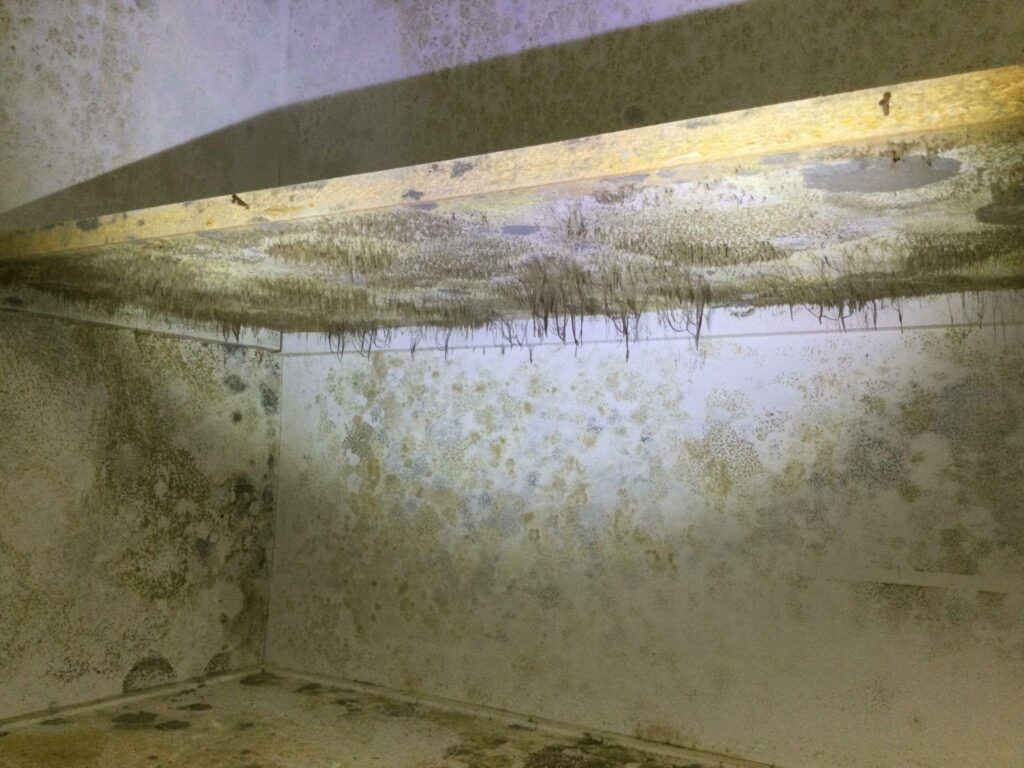
Black, green, or grey fuzzy patches on concrete, drywall, wood framing, or stored materials are the classic presentation. In humid conditions, active mold colonies look textured and are often slightly raised from the surface. In drier periods — or on surfaces where air movement has desiccated the colony — they may appear flat, powdery, or faded to white or grey.
White thread-like growth on wood — often described as looking like cotton or cobwebs — is mycelium: the root structure of mold colonies. It’s often visible on wood framing near floor level, on the underside of subfloor decking, and on wood blocking in areas with persistent moisture. Its presence indicates an established colony, not an early-stage one.
Staining on drywall that presents as irregular dark patches — not the uniform water tide marks left by a single flood event, but spreading, irregular discoloration — is often surface mold growth. In finished basements, this staining sometimes appears at the very base of drywall walls, where the bottom of the sheet contacts the floor or where moisture migrating up from the slab is most concentrated.
The Hidden Locations That Visual Inspection Doesn’t Reach
The gap between what a visual inspection finds and where the mold actually is can be significant. The locations with the most consistent hidden growth are predictable once you understand where moisture accumulates most reliably.
The back face of drywall is one of the most common mold locations in finished basements. The paper facing of drywall pressed against a slightly damp foundation wall, with limited air circulation between them, is an ideal growth environment. The front face looks painted and normal. The back face can be extensively colonised. The only way to know is to open the wall.
The team at Aquatech Waterproofing in Hamilton routinely encounters active mold growth discovered when walls are opened for waterproofing work — growth the homeowners had no awareness of, in basements that didn’t obviously smell or show surface signs. The absence of visible mold is not confirmation that mold is absent.
The bottom plate of framed walls — the horizontal wood member sitting on the concrete floor — absorbs moisture from the slab and from any seepage that reaches floor level. It’s enclosed within the wall cavity, invisible once drywall is installed, and often the first structural member to show significant mold damage in a basement with ongoing moisture issues.
Insulation cavities are another location where mold establishes itself invisibly. Fiberglass batt insulation absorbs and holds moisture, creating sustained wet conditions inside the wall cavity that are invisible from either side. The facing of the insulation — typically kraft paper — is an organic material that molds readily.
Under flooring is the fourth common hidden location. Moisture that migrates up through the slab or enters through the floor-wall joint accumulates under flooring materials that don’t allow the concrete to breathe. Carpet backing, underlayment, and the underside of laminate or engineered wood flooring can develop extensive mold growth while the surface above looks and feels normal.
The Environmental Conditions That Tell You Mold Is Coming
If visible mold isn’t present yet, certain environmental conditions indicate it’s in the early stages of development or will develop under sustained conditions. These are worth monitoring specifically.
Relative humidity above 60 percent in the basement, sustained over days or weeks, creates the moisture conditions mold needs to establish. A basic hygrometer — available inexpensively at any hardware store — gives you a continuous reading. Seasonal spikes during humid summer months are normal and manageable. Persistent readings above 60 percent in cooler months indicate a moisture source beyond ambient humidity.
Condensation on cold surfaces — pipes, windows, the face of the foundation wall in summer — indicates that warm, humid air is meeting surfaces below the dew point. This condensation is a moisture source that feeds surface mold independently of any water intrusion from outside. In a basement with high summer humidity and cold foundation walls, condensation-driven mold can develop even in a structurally dry basement.
Efflorescence — the white mineral deposits that form when water moves through concrete and evaporates on the surface — indicates that the wall is actively conducting moisture from the exterior. It’s not mold itself, but it’s a reliable indicator that the moisture conditions for mold are present or developing. Efflorescence and mold growth are frequently found in proximity because they share the same cause.
What to Do When You Find It
The response to a mold finding depends on the scale and location.
Surface mold on non-porous materials — bare concrete, ceramic tile — can be cleaned and does not necessarily require professional remediation. The cleaning needs to address the cause as well as the symptom: cleaning mold off a concrete wall that continues to conduct moisture will result in regrowth, typically within a single season.
Mold on porous materials — drywall, wood framing, insulation, carpet — cannot be remediated in place. The affected material needs to be removed and replaced. Cleaning the surface of mold-contaminated drywall removes the visible growth but not the hyphal network penetrating the material, and regrowth is predictable.
Mold that has reached structural members — the framing, the bottom plates, the subfloor decking — warrants a professional remediation assessment before any work begins. The scope of affected material needs to be mapped before removal starts, and replacement framing needs to be installed in conditions that don’t reproduce the moisture environment that allowed the original growth.
In every case, the moisture source needs to be addressed before any remediation work is completed. Remediating mold and leaving the moisture source in place is the most common and most expensive mistake in the process.
The mold that costs the most is always the mold that was there the longest. Knowing where to look — and looking before you have to — is the cheapest form of mold remediation available.